



Hmm, Seems To Be Owl Season

March 26th, 2008

Owl Country is a short game I worked on in collaboration with several TIGSource regulars. We hatched the idea for the project during GDC, wrote the bulk of it while we were there, and added the finishing touches in the weeks afterward.


Download for Mac OS X or Download for Windows

The premise is that you are an owl tired of the sea of pigeons plaguing the Montreal skies, along with the humans indifferent to their infestation. It takes place over the course of one night, ending in sunrise, and you must swoop as many pigeons as you can in this period.

How To Play?

Spacebar Swoops. Steer your swoop with the left and right keys. Don’t hit lamps. You get more points for successive pigeons attacked in the same swoop and extra lives for knocking pigeons into humans.

How Did We Do It?

Aquaria’s Alec Holowka wrote the music. Adam Saltman, myself, Kevin Coulton, and Ivan Safrin did the art. Voice talent includes Goo developer Tommy Refenes, Fez superhero Phil Fish, and Raptor Safari troubadour Steve Swink, among others.

The game is written in straight C by Ivan, myself, and Alec, using OpenGL, SDL, FreeType for text, fmod for sound, and libpng for texture loading. Interestingly, the entire game was written on a sum total of five different MacBook Pros, and then the finished version was quickly ported to Windows.

Why An Owl?

After Gamma 256 ended this past November, a group of us were standing around outside Montreal’s Society for Arts and Technology chatting. Suddenly we heard a commotion above our heads and a pigeon dropped to the street beside us, freaked out for a second, and flew off. An owl had swooped in for an attack, failed, and had flown back several yards to perch in a tree.

And as we were all still processing this, pigeon feathers slowly floated down around us — eventually inspiring Owl Country.

Notes

It was a blast to work on a project with so many people I respect, and hopefully it will lead to other cool collaborative efforts in the future.

Read more on the Owl Counry TIGSource Forum Thread.

Apple’s Intriguing iPhone SDK

March 7th, 2008

Apple revealed details of its plan for third party iPhone and iPod Touch applications today. Overall, very cool. Gamewise, it’s fairly straightforward to get an OpenGL context up and running and to start playing around.

How powerful is the hardware?

The chipset and graphics coprocessor in the iPhone/iPod Touch is plenty powerful for creating games — It should handle several thousand textured polygons no problem.

The amount of RAM in the phone is equally impressive. And remember, the display is larger and higher resolution than the PSP, with more pixels than both of the DS screens put together.

Some Demos

Dan and I are working on some things for the phone and he’s put together a couple quick demos that show off the power of the hardware and the ease with which you can do cool things with the interface.

The first is a demo of bouncing balls which uses the touchscreen to spawn and the accelerometer data to define the gravity vector.


The second is a test of the hardware’s 3D rendering, which loads a few lowpoly textered meshes.


Distribution

What’s interesting is the distribution model. The App Store sounds like a marketplace similar to XBLA and PSN, except of course not limited to games. The 70/30 ratio is good, but it remains to be seen how content will be promoted in this store.

Apple already has a section of the iTunes store devoted to iPod games. So will there be a two-tiered approach where big-publisher projects get heavy visibility and other stuff has to fend in a flood of content? Sites like Versiontracker are becoming hard to use because of the volume of content they track, and sifting through it is tedious.

There has been some consternation about a flip-flop in the price structure on one of the consoles’ downloable games portals lately. Hopefully Apple’s 70/30 ratio remains stable.

Wrap-up

When you consider the novel interface, the straightforwardness of the API, and the access granted for anyone to develop for the device, it seems likely that we’re going to see some really amazing things made for the phone.

A Game By Any Other Name Would Still Be Shit

March 2nd, 2008

I recently returned from an epic West Coast odyssey, bookended by both Macworld and the Game Developer’s Conference. Somewhere in between those major events, I made this:

Download Shit Game (Windows)

I’m not really sure how to explain this little project. I developed it in about a week, and the initial impetus for creation actually came after watching this video on YouTube

I suppose if you wanted to be intellectual, you could look at this game as a statement about creativity in the game industry. Entirely too much time is spent meticulously recreating the gameplay of previously developed games.

This is true in both the mainstream and independent game development spheres. Look at the countless Cave Story homages, as well as the countless iterations of games like Super Monkey Ball, Madden, Smash Bros, etc

I’m not saying this is entirely a bad thing. Recreating the mechanics of a classic is a fantastic way to cut your teeth in game development. In fact, there’s something even endearing about this, especially when a game fails to accurately capture the finesse of the original and it becomes fun to discover and exploit all of the bugs in its engine.

But, as the name implies, it’s hard to take Shit Game too seriously. And I feel kind of silly talking so much about it already. Don’t be fooled by the trailer. The in-game soundtrack consists entirely of poptunes recreated in general MIDI.

Download the Windows version — Mac users can play the game through CrossOver or other virtualization software. I may do a quick OS X port when Apple releases Java 6.

Adieu, Macworld

January 19th, 2008

I’ve been in San Francisco for the last week, running the Macworld booth for Danlabgames.

Besides showcasing all of Dan’s games, which went over very well, I tested out a rough demo of Rotrix on the crowd, leading to an estimable response from both gamers and some industry publisher people.

Receiving positive feedback felt very encouraging after pouring so much work into the project, and we’ll see where it leads.

Space Barnacle also seemed to be a hit, and looks fantastic on a glossy 24″ iMac. Going with the 1.6:1 aspect ratio totally paid off. It feels so mischevious to completely fill that high resolution display with a miniscule 288×180 pixel game.

I should be able to release a Mac port as soon as Apple releases Java 6, which, knowing Apple, will only be supported in Leopard… even though it’s been out for nearing 2 years on Windows, Linux, and Solaris. The rumor is that now that the Macintosh is on Intel architecture, they’re just porting the OpenSolaris version instead of rolling their own… which currently means 64-bit intel only? I don’t know, but it’s kind of sucky.

There’s something in the air

That brings me to Apple’s big announcement. The MacBook Air is light, underpowered, and overpriced.

No optical drive, slow hard drive, terrible integrated graphics, only 1 USB port? These are all things I need, but of course if I had a desktop at home, and I didn’t do graphics-intensive game development… and I was rich, maybe it’d be more attractive.

Stake your claim

The real buzz of the conference was iPhone development, even though few details on the SDK were announced at the keynote. A lot of developers are already working on projects with the reverse engineered headers.

Paul Kafasis likened the iPhone to the switch from Classic to OS X. These next few months will be like the wild west, and those that stake a claim early with quality software will have a really solid foundation in the future.

With 4 million phones sold already, and another 10 million forecasted by the end of the year, along with an untold number of iPod Touches, it’ll be a populous platform. And Cocoa developers will have an intimidating head start.

GAMES

Of course there’s a huge potential for games on the iPhone and iPod Touch. Just the hardware specs run circles around the DS. They’re equipped with a 660Mhz ARM1176 with a 3d graphics co-processor for hardware accelerated rendering, and include 128mb of main RAM, to say nothing of the gigabytes of speedy flash storage and wifi. And apparently, they’re running OpenGL ES 1.1 and SDL has already been unofficially ported.

A friend noted that if the iPhone were a game console, it’d already be the fastest selling console in history.

On Monday I was interviewed by San Francisco’s ABC 7 affiliate, for a story on mobile gaming. Bizzare and fun, with some footage from Wacky Mini Golf and Rotrix.

I’ll be staying in the bay area through GDC, so I’ve got another giant Moscone event to look forward to. Apple being Apple, the late February launch of the iPhone SDK may very well be after that — February 29th even.

Addendum

One of the best parts about events like Macworld is that it provides a chance to meet and knock around with all the great people of the Mac and tech scenes, some of whom you only see once a year.

I have to give a shoutout to the Picturesque guys, who had the booth next to me. Keep doing great stuff, and send me some of those photos!

Fun fact: Derek Yu, the editor of Tigsource and artist of Aquaria interned at Panic a couple years back, working on a cancelled project that Cabel showed a screenshot of during his session at last year’s C4. I knew that pixel art looked familiar.

Apple Pippin: Ahead of Its Time and Doomed Even Before the CD-ROM Booted

December 17th, 2007

“We think that Pippin represents the Next Generation of a lot of the things you’ll be seeing from Apple”.

That is eerily prophetic, as the parallels are clear between the Pippin and the Apple TV, and more so with the more widespread contemporary trend of the set-top media box.

And from a developer’s standpoint, this promotional video highlights a lot of the the same things that Steve Jobs extolled during the iPhone introduction — It’s running the full version of Mac OS! Development is easy!

However the parallels between the Pippin and the 3DO are also easy to draw, and it’s easy to see why the system failed.

A third party, Bandai, manufactured and marketed the device. It was developed in the pre-NeXT acquisition mid 1990s, a grim time for Apple. To start the device, you had to insert a system disc into the 4x CD-ROM drive and wait for a streamlined version of Mac OS System 7 to boot. The graphics were all done in a PowerPC native version of QuickDraw, a graphics API that in its more than 20 years of existence, never supported more than a 1-bit alpha channel!

So many nightmares.

But the kernel of the idea was good. And it’s especially ironic today as the Xbox 360, Playstation 3, and Wii are all running on PowerPC architecture. The Pippin’s PowerPC 603e is the forebear of these consoles’ brains.

Watch carefully, and you will see the Pippin port of Bungie’s Marathon in the video — a game which you can now play on XBox Live Arcade. Here’s a full list of Pippin software releases. And more information including full hardware specs is available on the Pippin’s Wikipedia entry.

Trekking Across the Northeast for Gamma 256 and Blip

December 3rd, 2007

I’m on my way back from New York today after a whirlwind tour of the Northeast. Kokoromi contacted me last week to let me know they’d be showing my experimental low resolution game, Standard Bits, at their Gamma 256 exhibition.

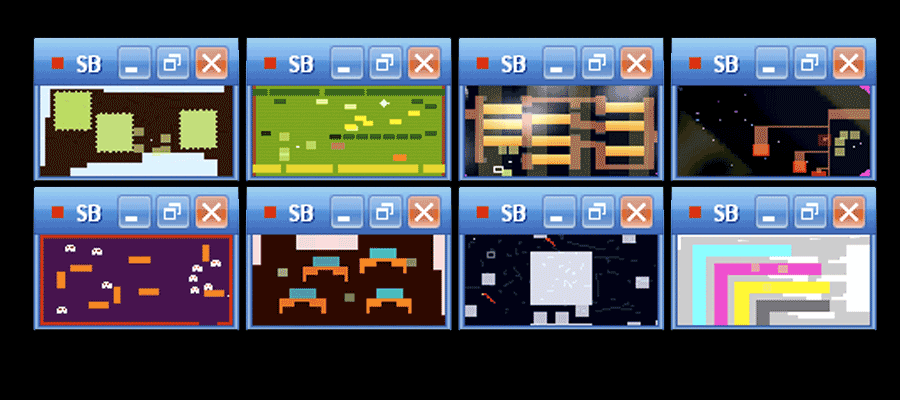
Gamma was the final event of the Montreal International Games Summit and it showcased 8 low-res games projected on giant screens at the city’s Society for Arts and Technologies show space, set to live performances from New York microtune artists and DJs. My friend Guy English (developer of Rogue Amoeba’s new Radioshift and former Ubisoft engineer) lives in the city, and he graciously agreed to provide a couch to crash on.

It all sounded too awesome to miss, so I flew out to New York and took a train up to Quebec. Let me just say, the French Canadian accent is truly bizarre — Fargo meets Inspector Clouseau.

The games could not exceed 256×256 pixels, and I had decided to go with a resolution of 100×54. To put that into perspective, that’s less than a third of the screen area in a pre-Leopard Mac OS X icon.

The main character is a single pixel, and the left analog joystick is the only control. The game’s environment is populated with entities that actively seek to attack you, as well as creatures that follow and protect you. You may also encounter ambivalent hazards and innocuous inhabitants going about their own pixellated business. The idea was to create a dynamic world with complex interaction while using very simple input.


Download Gamma 256 Build


Longtime Mac developers might recognize that the name comes from StdBits(), which was the low-level pixel blitter in QuickDraw.

Opposite my game was Alec Holowka’s Celu. and I was flanked by Jason Rohrer’s Passage on the left, and the lowest resolution game of the event by far, the 8×8 pixel Dodge Club to the right. TIGSource was well represented, with 4 of the 8 games on display coming from TIGS regulars, games such as Bloody Zombies, Petri Purho’s feast of zombie-cutting action and liquid blood dynamics which was placed wisely near the bar.

Though not the most graphically polished of the lot, Guy and I both took a huge liking to Mr Heart Loves You Very Much by TIGS regular Jimmy Andrews. It has a simple, fresh game mechanic that combines puzzle and reflex in a really fun way. And its svelte control scheme would make it ideal for something like the iPod Classic, or even the iPhone/Touch, making use of its accelerometer to change orientation.

Bubblyfish and the guys in Anamanaguchi (who both performed great sets) encouraged me to check out the Blip Festival in New York over the weekend, so I decided to extend my trip.

Blip was great. It was full of energy and crunchy melodies, with musicians from around the world. I captured some video from the iSight in my MacBook Pro which I’ll post when I’m more settled in back home.

One of the most surreal and awesome moments of the trip came when someone at a Blip after-hours in Brooklyn asked me if I’d played “Doomlaser’s Space Barnacle”. We ended up talking quite a bit and, hey, if you’re out there, I’d love to see the photos you took!! I think there’s a funny/terrible one with Paza Rahm (a Swedish Atari-ST afficianado who did an 8-bit remix of ‘Girl’ for Beck).

Paza and I got into a heated discussion about platforms, open source, and how government provided social mechanisms (or the lack thereof) influence cultural outlooks and output on both. He also gave me some new insights into why Sweden continues to allow The Pirate Bay to operate.

I met so many interesting, driven, and friendly people on the trip that it’s hard to process. At Gamma, Standard Bits was played constantly from 5:30 pm until after midnight when the event was shutting down and people, both in and outside the games industry, gave me some very inspiring feedback.

The game isn’t in a completely finished state, but if you’d like to try the build that was played at Gamma 256, you can download it here. It is a Windows executable, though it will most likely make it’s way to the Mac soon.

The Gamma photos were taken by Ivan Safrin. More are available here.

Thanks to all the Kokoromi people for hosting such a cool concept and event. I loved Montreal and I’m looking forward to spending more time up there if you do one next year,

Super Mario Galaxy: A Visual Tour

November 13th, 2007

I picked up Mario Galaxy last night and have been enjoying it, both as a game, and also picking it apart technically. The level design really stands out in how it consistently surprises you with creative platforming gameplay.

But what’s more interesting is how Nintendo is using the modest Wii hardware to achieve its graphical effects.

I could never quite tell from the YouTube previews, but it appears Mario’s using something like stencil shadow volumes to handle all its shadows– which are always projected in gravity’s direction. Unfortunately this technique means unsmoothed edges and a uniform brightness for all shaded areas. Side effects include moving platforms whose shadows suddenly blink onto surfaces when they approach, and suddenly disappear as they pass.

An element that Galaxy uses all over the place to great effect is something like a fake rim lighting shader. From what I understand, the Wii isn’t fragment shader capable, so maybe they’re faking it by setting an independent directional light aimed reverse relative to camera for each rimlit object? I’ve read a few things about the Wii’s Register Combiners and TEVs, and I wonder if they’re using them for pixel shadery purposes.

It’s all that lighting around the silhouettes of objects that helps give the characters and environments that signature plastic pop.

The fur shading is fairly nice as well, and I wonder how they’re doing it on the Wii hardware, whether it’s an actual shader, or they’re doing tricks rendering a multilayered shell of increasingly translucent polygons like in Shadow of the Colossus

Anyway, I am really enjoying the game so far, and the art direction is top notch. It’s also great to play Mario along to a live orchestral score — too bad Nintendo didn’t make the switch in time for Twilight Princess.

The shadows are the only real graphical let-down. It seems like they could be doing something more clever with the alleged crazy fill-rate on the Wii. Blurred textured shadow maps for near geometry or something? Also, multisampling would be nice, but playing on a standard def tv is forgiving.

I’d love to hear other people’s insights into the graphics behind the game. The rim lighting shading is something that could be easily applied to indie games looking for some eye candy punch…

Good Games are Hierarchies of Attainable Goals

October 18th, 2007

Kyle Wilson has written an insightful article called The Flow of Intentional Gameplay, where he picks apart survivalism and goals in videogames. He makes the case that good gameplay hinges on the player having readily identifiable goals at all times, and that games like Half-Life 2, and consoles like the Wii are successful because they are good at doing this.

Very interesting read. [via GameSetWatch]

Space Barnacle: What a Terrible Fate… to be Reborn in Space

September 28th, 2007

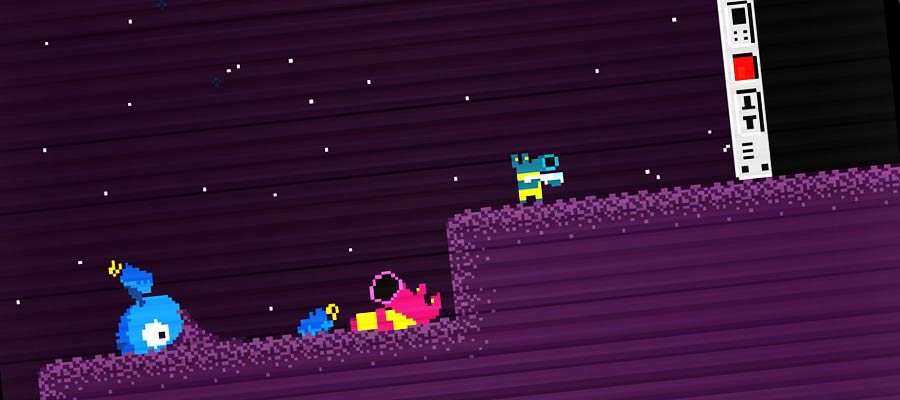
I’ve been hard at work for approximately the last month, creating a game. Space Barnacle is the end result: an ultra-violent pixellated platformer modeled in the 8-bit style.

The project came about as a result of a B-Game Design contest, hosted by the excellent Independent Gaming Source community, and writing it has been some of the most fun I’ve ever had in game developemt.

I wanted the game to feel like a long-lost budget title, perhaps developed for the NES or Commodore 64 somewhere between 1989 and 1990. Thus, the native resolution is 288×180 pixels, and most of the characters are a mere 16 by 16 pixels square.

My friend Kevin shared pixel art duties with me, and we tried to work from a limited 55 color NES palette. But we took some liberties, taking advantage of additive blending, parallax scrolling, and particle effects for blood and vomit explosions.

The music is composed entirely of chiptunes in Amiga module format, emulating the sound of the Commodore 64’s famed SID chip, and we were lucky to be able to include compositions by Reed Richards, among others.

In developing the engine, I was intrigued by the approach of Knytt, Within a Deep Forest, and Lyle in Cube Sector, which all used the rapid development environment, Multimedia Fusion.

Coming from a background of Mac OpenGL development, building a game in this environment was quite a shock. It both saved time, and caused endless frustration, as the method for logic control is completely insane.

In the end, I’m pretty pleased with what we came up with. We’re not done working on the title, and I’d really like to come up with a solution for an OS X port. I’ve been trying to hack together a little encapsulated Wine Binary Launcher for the game– sort of a low-rent version of Cider. This would have the added benefit of potentially bringing some other great indie games to the Mac.

Until then, Windows users can play the game natively, and Mac users can play pretty adequately through CrossOver, which has a free 60 day trial.

Download Space Barnacle

Product page

The Frustration of Being a Third Party Facebook Developer

September 19th, 2007

Back when Facebook’s much lauded platform API launched this past May, I wrote and released two apps. The first was a little screensaver for Mac OS X that grabs photos of your friends and creates a fun little Quartz Composer visualization. The second one was something I worked on with another guy I met in the facebook developers IRC channel.

It’s a little utility called Shortcut that allows you to very quickly jump to the profile, wall, or photo albums of any of your friends without an intermediate page load – kind of like an app launcher such as Quicksilver, except for your friends.

The second one lead to several webdev job offers I was totally unqualified for and a small but enthusiastic userbase.

So anyway, I woke up this morning and noticed that Facebook has added the functionality of Shortcut into their site-wide search bar, without so much as a courtesy e-mail. I suppose it was a fairly obvious idea, and the app itself used a feature provided by Facebook and most famously used in their photo tagging pages, so I can’t be that pissed… But I still feel a little swindled.

As an aside, I suspected Facebook might add this feature sooner, but figured they hadn’t because it would really slice into their pageviews. I guess this means it really is true that Facebook is more concerned with viewing time than page views, which is a great attitude for its users. Think about how many page loads it takes to do anything in MySpace.