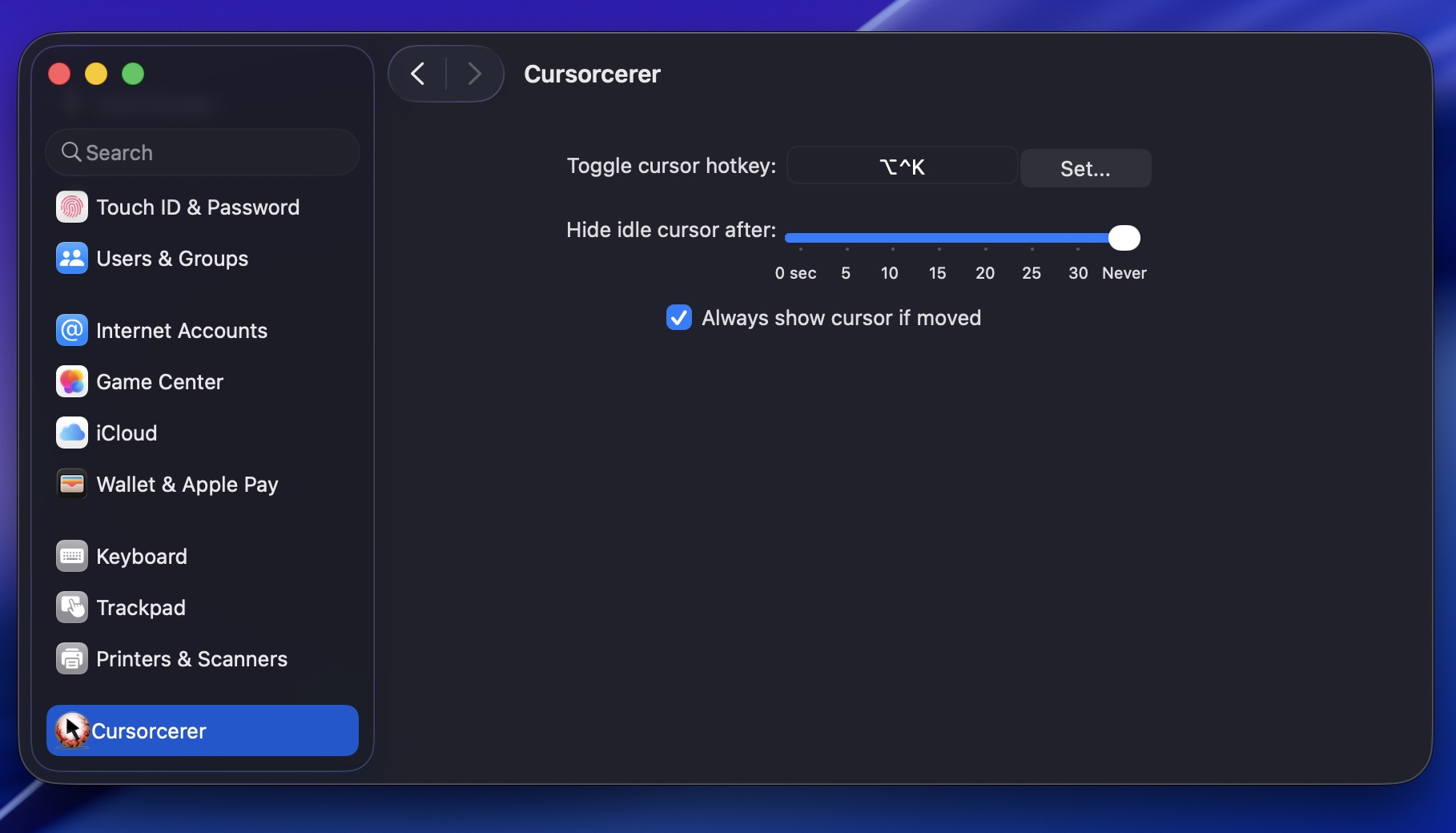
Cursorcerer is a little tool I hacked together which allows you to hide the Mac’s cursor at any time by use of a global hotkey. It can also autohide an idle cursor and bring it back as soon as you move the mouse.
The inspiration for this tool is one of my favorite and most utilized macOS features: the control-scrollwheel zoom trick. I use it all the time to make things like embedded web videos full screen. The trick’s only major downfall is that it’s a constant battle to get the cursor out of the way.
To install, just double click on the prefpane. Hit control-option-k to zap and unzap the cursor. If you want to uninstall, go to ~/Library/PreferencePanes/ and trash Cursorcerer.
The technique behind this global cursor hiding hack originates in a useful post to the Apple carbon-dev mailing list from Red Sweater’s Daniel Jalkut.
Cursorcerer 3.5 is signed, notarized, and works in macOS Tahoe, Sequoia, and Sonoma—and now natively supports Apple silicon Macs as well as Intel-based Macs. Legacy users can grab the 32-bit version here, or 2.0 here.
While hanging out in Chicago this past Friday, I decided to check out the line at the Michigan Avenue Apple Store in anticipation of the dramatic 6pm launch of the iPhone. It was nuts: cops on Segways, restaurants handing out free food, and a line that stretched around the entire block.
I tried taking a few pictures on my crappy cellphone, but realized that I could probably get better results from the iSight in my MacBook Pro. So I ended up walking around, holding my machine up and attempting to capture the general pandemonium.
Around 6:15, I went across the street to a Starbucks to see what kind of stuff I’d managed to get, and quickly spliced it together into a little video in iMovie.
When I came out, everyone in line had already gotten phones, and I could finally wander into the store to try out some of the demo units on display.
I guess my thoughts echo those of mostreviews. Really nice flashy interface, and my few minutes of trying to type ‘doomlaser.com’ into the touch screen made me want to destroy it.
So awhile back I was thinking, “You know what would be funny? A screen saver that fakes a kernel panic!”
For those of you who might never have seen one, a kernel panic is basically the most shocking crash that you can get on a Mac. It’s Apple’s equivalent to the famed Blue Screen of Death.
What a great way to play a prank on someone, or frighten yourself.
So here is the end result, a harmless screen saver that faithfully emulates the horrifying experience of a kernel panic. It comes complete with a misleading Quartz Composer Preview so that the effect is all the more terrifying.
Update: KPSaver is now 64-bit and compatible with Mac OS X 10.6 and above. Legacy users can download the old version here.
Since then, Doomlaser has stayed intentionally small, hands-on, and oriented toward experimentation at the edges of games and tools, including recent exploration of neural-network-driven workflows for game systems and creative software.
In parallel with games and tools, Doomlaser has spent the past decade exploring how abstraction, systems design, and institutional choices shape creative outcomes.
This line of thinking dates back to a 2015 public radio interview on WEFT 90.1 FM, where Mark framed artificial intelligence as a form of massively parallelized high-level algebra—powerful, non-mystical systems whose impact depends less on raw capability than on architecture, incentives, and governance.
That perspective now directly informs Doomlaser’s current work on Dream Factory: a performance-first creative infrastructure for working with scripts through rehearsal, iteration, and canonization, rather than one-shot generation.
Current focus
Alongside building original games and tools, Doomlaser occasionally works with other studios, founders, and research teams in a small, deliberately limited advisory capacity.
This work is not contract development or outsourced implementation. We instead focus on early-stage technical and creative judgment: helping teams clarify system architecture, surface hidden failure modes, and make high-leverage decisions before committing months or years of effort.
Typical engagements take the form of short, bounded conversations or reviews around topics such as:
• Evaluating whether an idea should be built at all—and if so, how
• Game & tool architecture at early, unstable, or transitional stages
• Diagnosing complexity, technical debt, or stalled projects
• Creative tooling and AI-assisted workflows where human authorship matters
This work is best suited to early conversations, inflection points, or moments where a project feels stuck or directionally unclear.
If the framing above resonates and feels relevant to where your work is right now, you can reach out briefly at

 Cursorcerer is a little tool I hacked together which allows you to hide the Mac’s cursor at any time by use of a global hotkey. It can also autohide an idle cursor and bring it back as soon as you move the mouse.